By Mark Vaccaro
For more than 150 years, the Naval Undersea Warfare Center (NUWC) in Newport, Rhode Island, has supported the US Navy by tackling complex technological challenges in an unforgiving undersea environment. As warfare centers have innovated in the areas of sonar, sensors, electromagnetic systems, and unmanned systems through decades, a relatively new challenge has emerged — how to operate effectively in the subsea and seabed battlespace.
For the submarine fleet, subsea and seabed warfare (SSW) provides a decisive advantage in the undersea domain by extending warfighting capabilities beyond the limitations of manned platforms. SSW has the potential to revolutionize undersea warfighting by enabling access, operations, and a sustained presence at all depths, including the strategically vital deep ocean, seabed, and contested littoral areas.
To achieve undersea dominance, the Navy must command the entire ocean depth, including areas beyond the reach of manned submarines and surface ships. This is the essence of subsea warfighting: the ability to operate and maintain a persistent presence at all depths.
These operations are inherently complex, unfolding in harsh, remote locations where reliable communications and global positioning system navigation are often unavailable, demanding innovative solutions and high degrees of autonomy. The challenge is significant as SSW operations are best characterized by the 5 Ds: deep, dark, difficult, dangerous, and denied environments.
The Role of Warfare Centers
Warfare centers are essential to maintaining the Navy’s technological edge. They explore what combinations of existing technology will work for SSW and what capabilities complement the web of missions at the seafloor. Focusing the warfare center enterprise on the new domain of SSW will undoubtedly require adaptation of current business operations to include increased agility, risk tolerance, and enhanced collaboration with industry and academia.
Throughout 2025, the warfare center enterprise assessed existing SSW capabilities and identified gaps and needs. In 2026, the enterprise is looking to work with partners in industry, academia, and other research centers to complete the SSW vision.
The Role of Industry
Industry is innovating in areas such as acoustic and optical modems, software-defined modems, optical communications (both LED- and laser-based systems), unmanned vehicles, and undersea wireless mesh networks.
Among sectors, oil and gas, deep-sea mining, offshore renewable energy, and telecommunications are developing technologies that lend themselves to applications in defense and security.
The oil and gas industry drives subsea technology development in ROVs, systems that connect seabed infrastructure to surface facilities, and specialized connectors and tools to install and maintain seabed infrastructure.
Deep-sea mining focuses on exploring the ocean floor for minerals. Technologies being developed include high-resolution sonar and lidar systems, vertical transport systems, and AUVs.
Within the offshore renewable energy sector, technology is being developed for seafloor surveying, cable laying and installation, and ROV/AUV inspection and monitoring.
The telecommunications industry — responsible for the fiber-optic cables that support most international internet and phone service — is developing technologies for cable installation and repair, seafloor surveying for cable routes, wet-mate-able fiber-optic and electrical connectors, and seabed cable protection, an area of vital strategic importance.
Collaboration
The warfare center enterprise has numerous shared equities with industry in SSW, and collaboration is critical to moving fast in this area.
In 2025, NUWC Newport supported two in-water demonstrations for SSW. The Blue Technology Innovation Demonstration Event (BlueTIDE) included industry partners with an array of technologies related to autonomous vehicles, sensors, resilient communications, and high-resolution underwater imaging.
The Office of Naval Research sponsored the Technology Operational Experimentation Event, featuring industry partners demonstrating their technologies in support of resilient communications, long-range transit for underwater vessels, and sensing/detection.
Both events took place at NUWC Newport’s test facility, with Navy engineers and scientists coalescing on the unique problem set.
These in-water experiments and in-person, real-time collaboration will continue to speed delivery of SSW capabilities to the submarine fleet.
Looking Ahead
As the Department of War updates acquisition policies to get technology to the warfighter faster, the Navy continues to use Other Transaction Authority (OTA) to develop, test, and field new capabilities. Around since 1958, OTAs offer the government flexibility to incorporate commercial industry standards and business best practices into the process of awarding contracts. The government historically employed OTAs in conducting research and development, and in 2016 the National Defense Authorization Act expanded the use of OTAs to include prototype and production.
For SSW in 2026 and beyond, OTAs will play a critical role in how the Navy partners with industry for emerging subsea and seafloor systems.
***
Mark Vaccaro is the senior scientific technical manager for Subsea and Seabed Warfare at the Naval Undersea Warfare Center Division Newport.
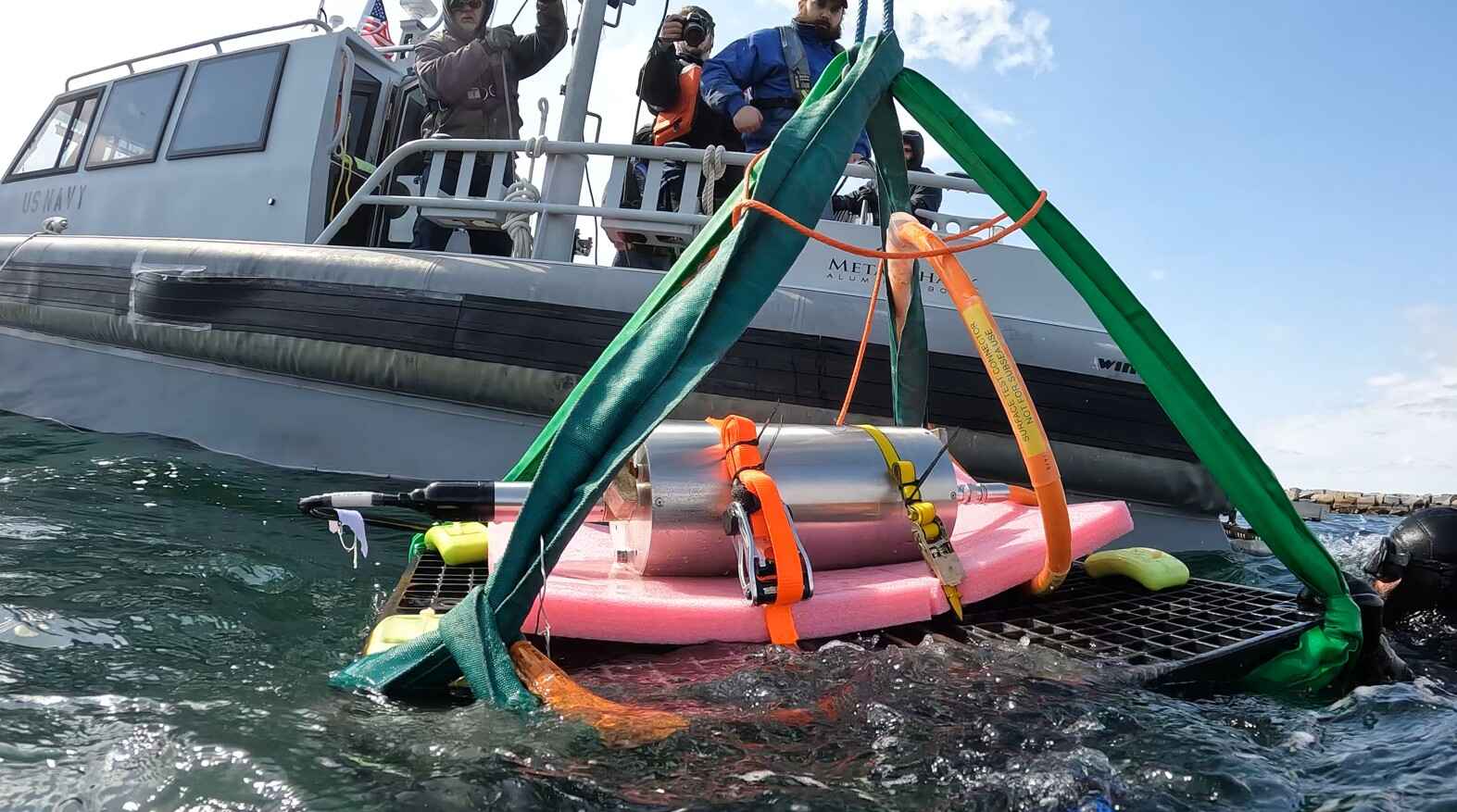
Image: At NUWC Newport’s Narragansett Bay Test Facility, a power and energy unit is lowered to the seafloor to allow for experimentation of seabed technologies with industry and other government laboratories. (Credit: Naval Undersea Warfare Center Division Newport)